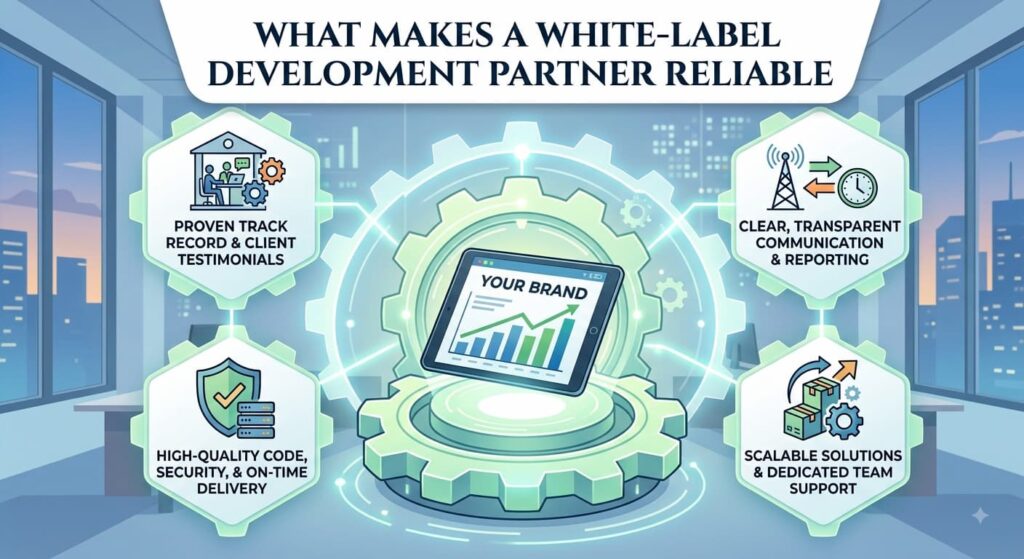
A reliable white-label development partner is one whose behavior an agency can predict when a project becomes less predictable. Good code and quick replies matter, but they are not enough. The harder test is what happens when requirements are incomplete, a dependency blocks progress, scope changes, defects appear, or a developer becomes unavailable.
Agencies can evaluate reliability in three stages. Before hiring, they can inspect evidence, estimates, ownership, and working practices. During the first project, they can observe how the partner handles ambiguity, risk, QA, and change. Over repeated projects, they can see whether those behaviors remain consistent as workloads and people change.
Reliable development partners make delivery predictable, not merely fast
Portfolios, technical stacks, hourly rates, promised turnaround, and response speed are useful screening signals. None of them proves that delivery will remain controlled once the work starts.
A stronger test is predictability across scope, timeline, quality, escalation, change management, and handoff. Fast delivery is useful only if the agency can also understand what is being delivered, what can change the schedule, how defects are handled, and when a problem will be escalated.
DORA’s software-delivery metrics offer a useful parallel. The framework looks at both throughput and instability rather than treating speed alone as performance. Its measures include change lead time, deployment frequency, failed-deployment recovery time, change-failure percentage, and deployment rework rate.
Dmytro Mashchenko, COO of GetDevDone, describes predictability from the delivery side:
“Most development projects look straightforward while everything follows the original plan. The more useful test comes when something changes: a requirement needs clarification, the client adds functionality, or a technical dependency affects the estimate. Reliable delivery means having a process for dealing with those situations without losing control of scope, timing, and responsibility.”
Before hiring, test the evidence behind the partner’s promises
Ask for comparable work — then ask how it was delivered
A finished portfolio shows what a development company has produced. It says much less about how the work was managed.
For a comparable project, ask what made delivery difficult, what changed after development started, how corrections were handled, what the partner was responsible for, and whether the work was part of a recurring agency relationship. A vendor that can explain the problems behind a successful project gives the agency more useful evidence than one that can only show polished screenshots.
The important question is not simply, “Have you built this type of site?” It is, “What happened when a similar project stopped following the original plan?”
Examine the estimate, not just the number
A reliable estimate should expose uncertainty instead of hiding it. Look for assumptions, dependencies, exclusions, unclear requirements, technical unknowns, required client inputs, and a defined approach to changes that affect budget or timeline.
A firm price and deadline can look reassuring. If the requirements are still vague, that certainty may not be justified.
Requirements management deserves particular attention. PMI research has linked inaccurate requirements management with unsuccessful projects and identifies scope creep and communication problems among the issues connected with requirements.
Find out who owns delivery when people change
Verify who owns the project, who communicates with the agency, where project decisions are documented, and how another developer would take over if needed.
If one person holds the requirements, implementation history, and client context in their head, the agency is relying on an individual rather than a delivery system. That may be acceptable for a small one-off task. It is a larger risk in a recurring white-label relationship.
The first project reveals how the partner behaves when reality changes
Proposals and references can narrow the shortlist. A first engagement shows how the development partner actually operates.
Watch what happens when requirements are unclear
A reliable partner asks questions before implementation, identifies contradictions, clarifies acceptance criteria, explains technical consequences, and challenges an approach when necessary.
The opposite behavior can feel easier at first. The vendor accepts every request, starts immediately, and treats each feature as straightforward. The cost appears later when different assumptions surface in QA or near the deadline.
Technical judgment sometimes creates friction early to prevent much more expensive friction later. A partner that says, “We need to clarify this first,” can be safer than one that says yes to everything.
Evaluate how risks and bad news are communicated
Good communication is not mainly about replying within a set number of hours. The more useful test is whether a delivery risk is raised while the agency still has time to act.
When something changes, the partner should explain what happened, what it affects, and what realistic options remain. The agency then has time to adjust scope, timing, or client expectations.
Late escalation is particularly damaging in white-label work. The end client still holds the agency accountable, even when the implementation is being handled by another company. Frequent status messages do not compensate for learning about a serious problem only after the deadline has slipped.
Check where QA actually happens
The agency should not become the vendor’s primary QA layer simply because its team is the next to open the build.
Before the first delivery, find out what is reviewed, whether functionality is checked against requirements, how responsive behavior is tested, how defects are recorded and corrected, and who decides that work is ready for agency review.
DORA’s guidance on test automation supports the broader principle of getting quality feedback throughout delivery rather than leaving validation until the end. That does not mean every website needs a large automated test suite. The depth of testing should fit the project. The process should still catch routine defects before the agency does.
White-label reliability includes protecting the agency-client relationship
A technically capable development company can still be a poor white-label partner. Reliability also depends on how well the partner respects the agency’s ownership of the client relationship.
First, define client boundaries. Decide whether the development partner can communicate directly with the client, under whose identity, who can approve changes, who discusses pricing or scope, and which conversations must stay with the agency.
Second, check how access and confidential information are handled. An NDA matters, but a contract does not explain how credentials, repositories, staging environments, production access, client data, third-party accounts, or subcontractors are controlled in practice. The UK National Cyber Security Centre’s supplier-assurance guidance recommends examining supplier access and security controls directly, including privileged access and whether users receive only the access they need.
Third, match the security check to the project. A brochure site does not require the same assurance as a build involving accounts, payments, sensitive data, integrations, or substantial custom functionality. NIST’s Secure Software Development Framework supports building secure practices into the software-development lifecycle rather than relying on a contractual promise alone.
Long-term reliability means the process survives individual projects and people
One successful project proves that one project went well. It does not yet prove that a vendor can deliver consistently across changing workloads, deadlines, and team members.
Over repeated engagements, look for consistent estimation logic, quality standards, documentation, escalation, and change handling. The partner should retain useful knowledge about the agency’s requirements instead of forcing the agency to rebuild the working relationship from zero each time.
There is also a difference between individual reliability and organizational reliability. “This developer is excellent” is an assessment of one person. “The partner can keep delivering when people or workloads change” is an assessment of the company behind that person.
Not every agency needs that level of organizational maturity. A freelancer or specialist can be fully adequate for occasional, narrow tasks. Organizational reliability matters more as the external team takes responsibility for several projects, recurring delivery, or a larger part of the agency’s client workload.
Warning signs that reliability may break under real project pressure
Some warning signs are visible before a contract is signed; others appear during the first project. None automatically proves that a vendor will fail, but each deserves a clear explanation before the agency increases its dependence on the partner.
| Warning sign | Why it matters |
| Firm estimate despite unclear requirements | Uncertainty may have been hidden rather than resolved. |
| Few questions before starting | Important assumptions may remain undiscovered. |
| Every request gets an immediate “yes” | Technical and delivery risks may not be challenged. |
| QA begins when the agency reviews the work | The agency is effectively part of the vendor’s QA process. |
| Problems are reported only when deadlines slip | The agency loses time to manage its client. |
| One developer holds all project knowledge | Staff changes can disrupt delivery. |
| Scope changes are handled informally | Budget and deadline expectations can diverge. |
| No clear rules for credentials or client access | White-label and security risk remains unclear. |
The strongest white-label partner is not necessarily the fastest, cheapest, or most technically impressive candidate. It is the one whose delivery behavior the agency can understand, verify, and continue to rely on when client projects become less predictable than the original brief.
Frequently asked questions
Should an agency start with a trial project before choosing a white-label development partner?
A limited first project is useful when the agency expects to send recurring work to the partner. It gives the agency a chance to observe estimation, communication, QA, scope handling, and escalation under real delivery conditions.
The trial does not have to be artificially small. It should contain enough real project complexity to expose how the partner works. A task with no ambiguity, dependencies, or meaningful QA may prove technical competence without revealing much about delivery reliability.
What should an agency ask a development partner before the first project?
Ask questions that expose how the work will actually be delivered. These should cover assumptions in the estimate, project ownership, required client inputs, QA, scope changes, risk escalation, documentation, credentials, and client communication.
Questions about previous projects are also more useful when they concern delivery rather than technology alone. Ask what changed during a comparable project, what caused problems, and how the partner responded.
How can you evaluate a white-label partner’s technical skills if your agency is not technical?
Do not rely only on technology lists or polished portfolio screenshots. Ask the development partner to explain comparable work in plain language: what was technically difficult, why a particular approach was chosen, what risks existed, and how the finished work was checked.
The quality of the explanation is itself useful evidence. A technically competent partner should be able to explain consequences and trade-offs without requiring the agency to understand implementation details.
The agency can also examine process signals that do not require deep technical expertise. Good estimates identify uncertainty. Good QA happens before agency review. Good technical judgment produces questions when requirements are contradictory or incomplete.
What are the biggest red flags when choosing a white-label development company?
The strongest warning signs are usually unexplained certainty and weak delivery controls. Examples include a firm estimate for unclear requirements, almost no questions before development, immediate agreement with every request, informal handling of scope changes, and no clear QA process.
Late risk escalation is another serious warning sign. An agency needs to know about a likely delay while there is still time to manage the end client, not after the delivery date has already been missed.
Dependence on one developer and unclear rules for credentials or client communication also become more important as the relationship grows.
How should a white-label partner handle communication with an agency’s clients?
The rules should be defined before client communication begins. The agency and development partner should agree whether direct contact is allowed, under whose identity communication happens, who can approve changes, and who can discuss scope or pricing.
There is no single arrangement that suits every agency. Some agencies want the development team completely behind the scenes. Others allow direct technical communication. Reliability means following the agreed boundary consistently rather than assuming access to the client.
Is an NDA enough to protect client information when outsourcing development?
No. An NDA establishes contractual obligations, but it does not show how client information and system access are handled during daily work.
An agency should also understand how the partner manages credentials, repositories, production and staging access, client data, third-party accounts, subcontractors, and access removal after the project. Supplier-security guidance from the NCSC similarly treats supplier assurance as a matter of examining actual controls and access, not contracts alone.
The depth of that review should match the risk of the project. A simple brochure website and a custom application handling accounts or payments do not require the same level of scrutiny.
Is a more expensive white-label development partner usually more reliable?
Not necessarily. Price alone does not show whether estimates are sound, QA happens before delivery, risks are escalated early, or project knowledge survives a staff change.
A higher rate may accompany stronger delivery processes, but the agency still needs to verify those processes. A cheaper vendor can also be reliable if its scope, capabilities, and working model fit the project.
The better comparison is not simply hourly rate versus hourly rate. It is how much uncertainty the agency will have to absorb during delivery.
When is a long-term development partner better than hiring freelancers project by project?
A long-term partner becomes more useful as an agency sends recurring work, runs several projects at once, or gives the external team more responsibility for delivery.
In that situation, retained project knowledge, consistent estimation, common QA standards, documented processes, and continuity between individual developers reduce the need to establish the same working rules for every new project.
For occasional specialist work or low project volume, a freelancer may be entirely adequate. Organizational continuity matters most when external development becomes a recurring part of the agency’s client-delivery model.