AI photo restoration is the automated process of repairing damaged images using machine learning models. Different tools specialize in distinct problems, like scratch removal, color correction, or detail reconstruction.
Selecting the right service requires matching the tool’s function to the specific type of damage in your photograph. This list examines five options, ranking them based on output quality, processing stability, and operational simplicity. The goal is functional alignment.
1. Renew Photo
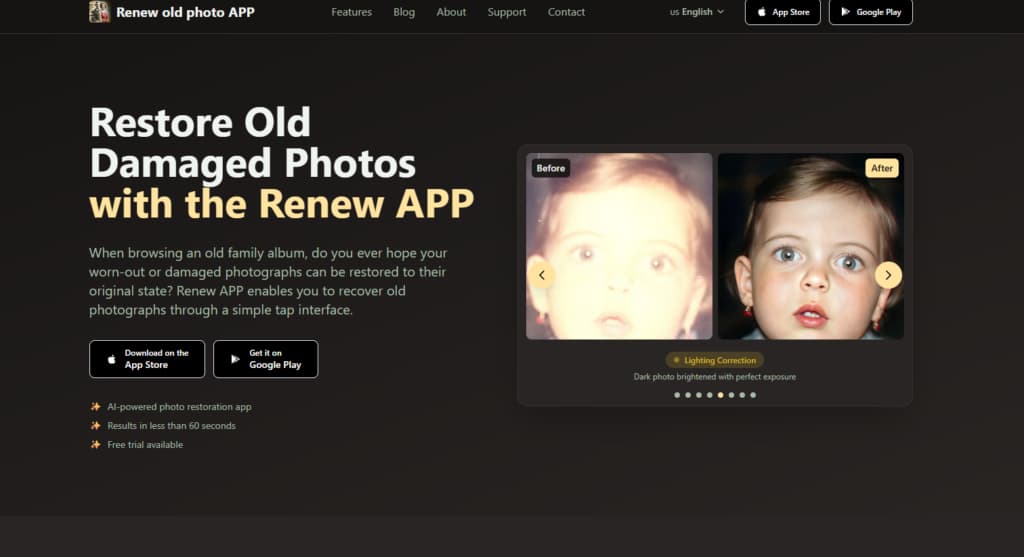
Renew Photo operates as a multi-stage restoration pipeline. It sequentially analyzes and corrects complex, overlapping forms of image degradation. This architectural approach is designed for photographs with severe, compounded damage where simpler methods fail. The system treats restoration as a layered problem requiring multiple AI interventions.
When Renew Photo Is The Appropriate Tool
This tool is appropriate when a photograph suffers from several simultaneous defects. It addresses cases where surface-level enhancement cannot separate intertwined issues like deep scratches, major fading, and structural loss. The process is necessary for images where the original data is significantly obscured or corrupted. Its application fits these scenarios:
- Restoring heavily damaged old photos;
- Reconstructing missing facial details;
- Removing deep scratches and structural noise;
- Correcting uneven lighting and severe fading.
For such advanced damage, a single-pass tool would likely produce inadequate results. The multi-stage method is the logical technical response.
Capabilities And Structural Limits
Its capability lies in automated, sequential damage detection and infilling. The system makes plausible reconstructions without user input, which is its primary strength. A key limitation is the absence of manual controls to prioritize certain repairs over others. The user accepts the AI’s judgment completely. Functionally, it provides:
- Multi-stage AI restoration pipeline;
- Automated damage detection and correction;
- Facial feature reconstruction;
- No manual prioritization controls.
This defines its operational envelope. It handles difficult restorations within a rigid, automated framework.
2. RetroFix
RetroFix executes a generalized, one-step AI restoration process. It applies a uniform model to correct common age-related deterioration quickly. The interface is minimal, built for speed over granular control. This makes it a practical utility for routine photo cleanup without technical overhead.
Where RetroFix Delivers Reliable Results
This service works reliably on photographs with predictable, moderate wear. It is for users who need consistent improvement across a batch of similar images, like a set of faded family pictures from the same era. The tool assumes standard damage patterns. It delivers on:
- Restoring lightly damaged photographs;
- Colorizing old family images;
- Fixing minor scratches and fading;
- Everyday mobile photo cleanup.
For most casual users, this level of automated correction is not just enough, it’s ideal. It solves the common problem.
Strengths And Functional Trade-Offs
Its main strength is speed and consistency, outputting predictably enhanced images with zero configuration. The functional trade-off is a lack of specialization. The model cannot adapt to unique or extreme damage cases that fall outside its training data. Key points are:
- One-pass AI restoration workflow;
- Consistent results across similar images;
- Limited recovery for severe damage.
The tool is functionally transparent. You know exactly what it does.
3. YouCam Enhance

YouCam Enhance functions primarily as an AI-powered general enhancer with integrated restoration features. It focuses on automatic improvements to clarity, color, and minor defect removal. The tool is built for a one-click uplift rather than deep, structural reconstruction of badly damaged photos.
Suitable Use Cases For Automatic Enhancement
This tool suits photographs suffering from generalized decline rather than acute damage. Think of images that are faded, low-contrast, or have light, uniform scratches. The enhancement is broad, applying a standard set of corrections to improve overall appearance. Its suitable tasks include:
- Enhancing faded or low-contrast photos;
- Removing light scratches and noise;
- Improving overall image clarity.
It serves a clear role: providing a quick, competent polish for images that are worn but not broken.
Feature Scope And Limitations
The feature set revolves around automated adjustments. It applies algorithms for scratch removal, color balancing, and sharpening in a single operation. The primary limitation is the lack of depth control; you cannot specify how aggressively it targets a specific flaw. Its operational scope covers:
- AI enhancement and scratch removal tools;
- Automatic color and lighting adjustments;
- Limited control over restoration depth.
It is an enhancer first. That classification dictates its utility.
4. Pixelbin
Pixelbin is a browser-based AI tool supporting batch processing of old photographs. It allows users to upload and restore multiple images simultaneously through a web interface. This format is built for processing collections efficiently, applying a uniform restoration model to each file.
Batch Restoration For Photo Collections
The batch functionality addresses a specific logistical need. It is for users with dozens of photos from a single source, like a scanned album, that share similar damage profiles. Processing them individually with other tools would be inefficient and inconsistent. Its designed function is:
- Restoring multiple old photos at once;
- Removing scratches and age-related defects;
- Maintaining consistent output across batches.
This approach saves time. It also ensures a uniform visual result for an entire set, which matters for archival projects.
Processing Capabilities And Constraints
The platform uses a standard AI model for automated restoration, handling typical flaws. A significant constraint is the operational model common to web tools: free usage often comes with limits on resolution, number of files, or processing speed. Its framework includes:
- Browser-based AI restoration;
- Batch processing support;
- Usage and resolution limits on free plans.
You exchange local software control for web-based convenience and batch utility. It’s a straightforward trade.
5. RestoreOldPhotos.io
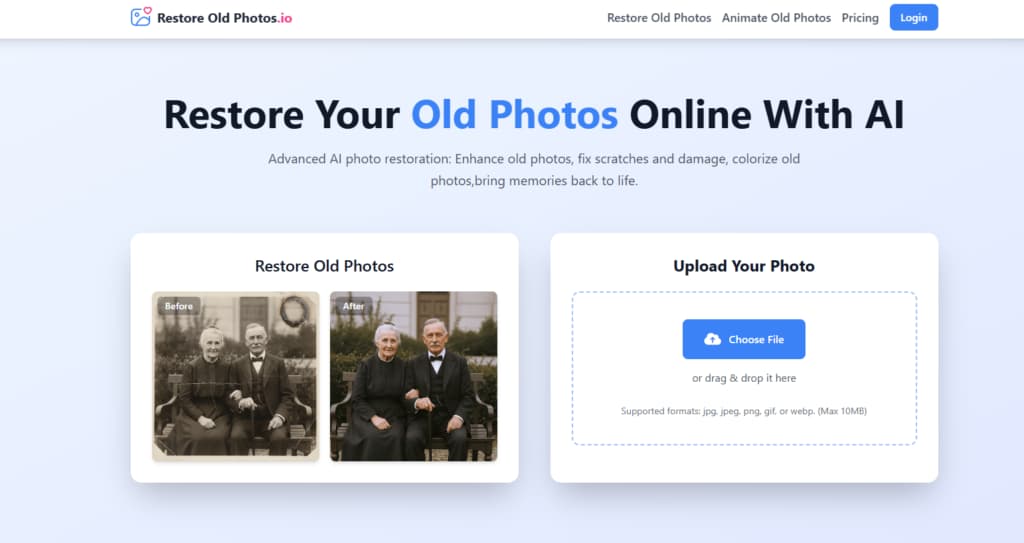
RestoreOldPhotos.io is a streamlined web service for fast, automated photo repair. It performs a standardized set of corrections like scratch removal and colorization directly in the browser. The tool prioritizes accessibility and speed for one-off restoration tasks.
A Lightweight Online Restoration Option
This option is logical for a single, moderately damaged photo needing a quick fix. It eliminates software installation. The process is simple: upload, wait for server-side AI processing, and download the result. It treats restoration as an on-demand utility. Its appropriate uses are:
- Fixing faded and damaged photos online;
- Removing scratches and discoloration;
- Colorizing black-and-white images.
For sporadic use, this model is often the most convenient path. It gets the job done without commitment.
Functional Coverage And Trade-Offs
The tool covers standard automated restoration and includes optional modules for upscaling or face enhancement. The trade-off is limited customization; the AI determines the repair strategy with little user guidance. It’s a black-box solution. Functionally, it offers:
- Automatic AI-based restoration;
- Upscaling and face enhancement options;
- Limited customization controls.
It provides a capable, no-frills service. You accept its automated decisions to gain simplicity.
Final Thoughts On Selecting A Restoration Tool
Choose based on damage taxonomy. For severe, multi-layered damage, use a multi-stage processor. For general fading in a collection, a batch web tool works. For a quick polish, a simple enhancer is enough. For one-off online fixes, a lightweight web service fits. Each class of tool serves a distinct technical need.
According to our analysts, the most frequent error is using a simple enhancer on a complex problem, which yields poor results. The tools are effective, but their application must be precise. Your starting point is always a clear diagnosis of the photograph’s condition. The rest is execution.