Modern sales teams rely on accurate business data to improve prospecting efficiency and outbound targeting. Poor-quality contact records, outdated company details, and weak segmentation create wasted outreach and lower response rates. B2B data tools now play a bigger role in prospect research, contact discovery, enrichment workflows, and outbound preparation. Different tools solve different sales workflow problems. Some focus on manual verification; others prioritize speed or predictive intelligence.
Some B2B data platforms focus on manual verification. Others prioritize enrichment workflows, contact lookup speed, recruiter-style prospect discovery, or intent-driven sales intelligence. Modern sales teams rarely rely on one type of data workflow anymore. The seven platforms below represent different approaches to outbound prospecting and business data management. Here is a quick overview:
- Emarketnow — Manually reviewed B2B prospecting data built for targeted outbound campaigns;
- Hunter.io — Email discovery and verification platform used for outbound prospecting;
- ContactOut — Contact enrichment platform focused on recruiter and SDR workflows;
- Datanyze — Lightweight prospect research and outbound sales tool;
- LeadIQ — Prospect capture and outbound workflow platform for sales teams;
- Clearbit — Business data enrichment and firmographic intelligence provider;
- 6sense — Revenue intelligence platform focused on intent-driven sales targeting.
Every platform below approaches business data differently, depending on workflow complexity, prospecting priorities, and sales structure. Let us dive in.
1. Emarketnow
A manually reviewed B2B prospecting data provider.
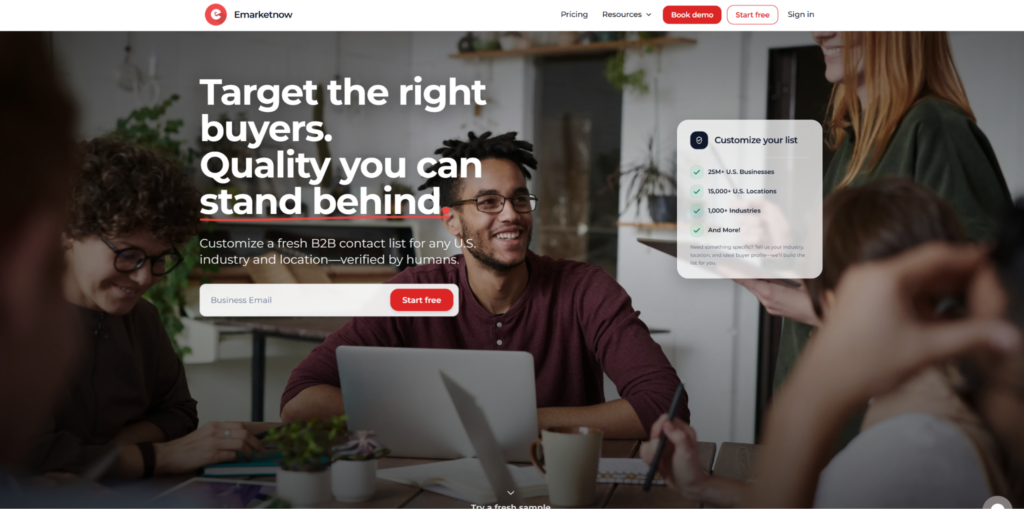
Emarketnow’s B2B data platform builds custom prospecting lists for outbound sales campaigns. You filter lists using industry, company size, location, revenue, and job titles. The company relies on manually reviewed contact records instead of automated mass scraping systems. Cleaner targeting and fresher prospect data shape its positioning. No automated junk here.
Emarketnow puts contacts through strict validation workflows before delivery. Role-based emails, catch-all addresses, and generic ISP emails get filtered out. Tighter industry filtering reduces irrelevant prospecting results during outbound campaigns. The company focuses more on targeting precision than exporting massive contact volumes. Main advantages include:
- Human-reviewed B2B prospecting data;
- Double-validated work emails and mobile numbers;
- ICP-based list building workflows;
- Strict industry segmentation;
- U.S.-focused outbound support.
Emarketnow works especially well for businesses prioritizing cleaner targeting, lower bounce rates, and manually reviewed contact data.
2. Hunter.io
An email discovery and verification platform.
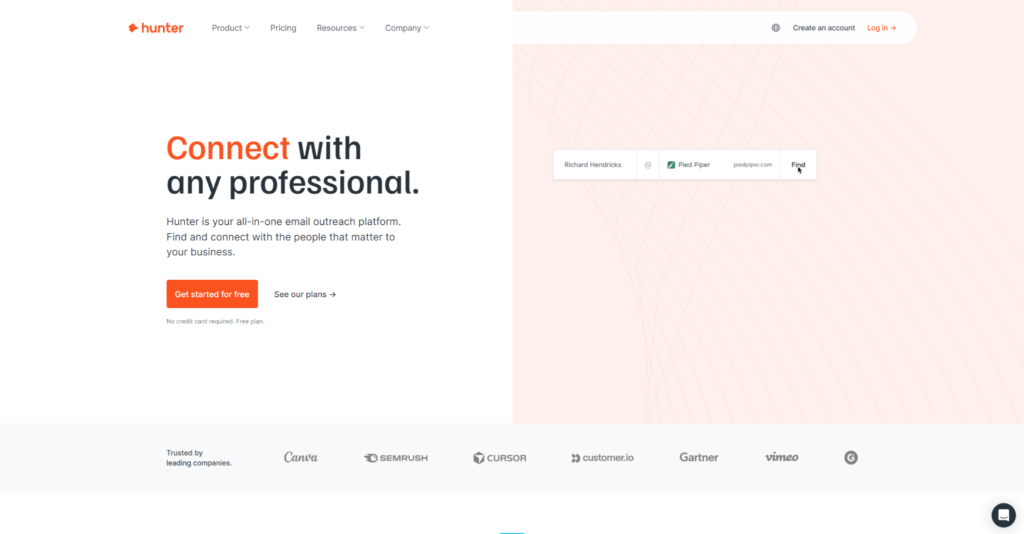
Hunter.io helps you find and verify business emails fast. Sales teams, freelancers, agencies, and recruiters use it during prospect research. The platform focuses heavily on speed and usability. No steep learning curve.
Hunter.io combines email search, domain-based discovery, and verification functions in one lightweight environment. Businesses use it during outreach preparation and lead qualification. Quick verification checks help reduce bounce rates during campaigns. The setup stays simple and direct. Core functions include:
- Domain-based email lookup;
- Email verification workflows;
- Chrome extension support;
- Faster outreach preparation;
- Lightweight contact discovery tools.
Hunter.io fits teams that prioritize faster email discovery and verification workflows during outbound prospecting.
3. ContactOut
A contact enrichment and recruiter-focused discovery platform.
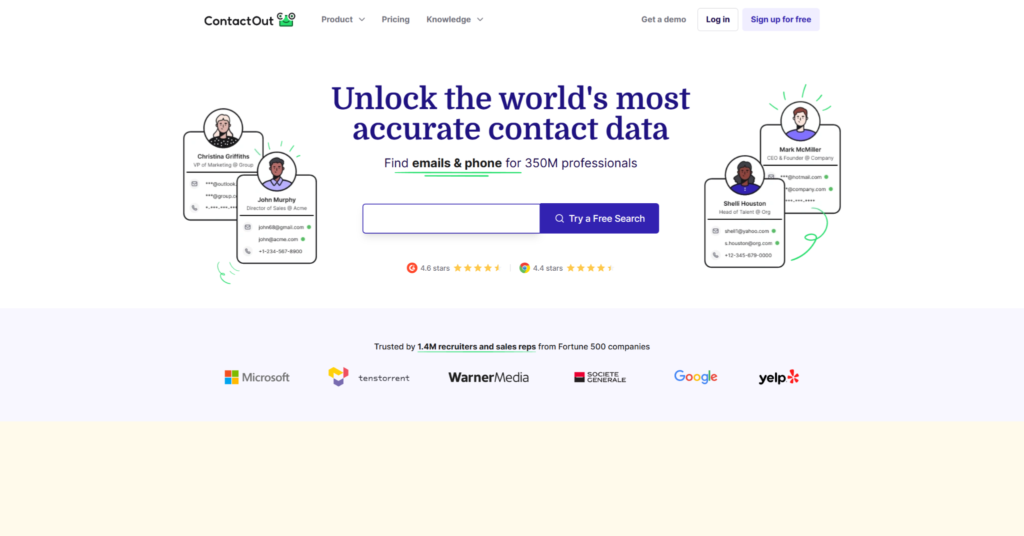
ContactOut helps with contact enrichment, recruiter sourcing, and outbound prospect research. SDRs and recruiters use it alongside LinkedIn workflows to find business emails and phone numbers. The platform emphasizes direct contact discovery rather than large prospect databases. Usability and speed drive its structure.
ContactOut focuses on enrichment workflows and direct contact sourcing during outbound campaigns. Many teams use it to supplement prospect research rather than replace larger outbound systems. Recruiter-style workflows influence the platform’s overall structure. Prospecting features include:
- LinkedIn-focused contact discovery;
- Recruiter-style sourcing workflows;
- Email and phone enrichment;
- Chrome extension integration;
- Faster prospect research support.
ContactOut appeals to recruiters and outbound teams needing direct contact sourcing during LinkedIn-heavy prospecting workflows.
4. Datanyze
A lightweight prospect research platform.
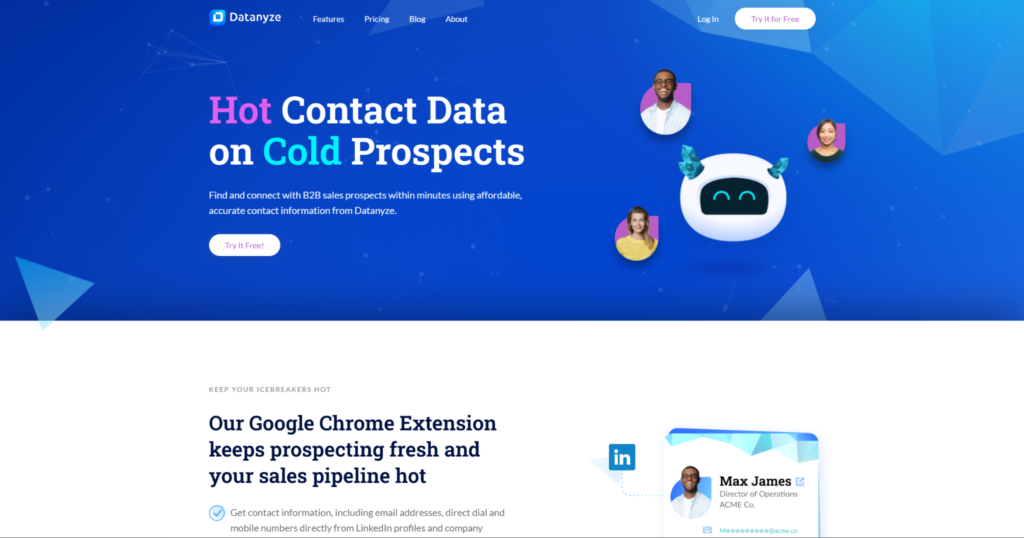
Datanyze focuses on prospect research and outbound contact discovery for smaller sales teams. Users value its simpler interface and quicker prospecting workflows. The platform emphasizes accessibility and ease of use instead of heavy enterprise complexity. Smaller organizations prefer tools with less operational friction.
Datanyze combines contact discovery, company insights, and Chrome extension workflows to support outbound prospecting. SDRs use it during faster-moving prospect qualification tasks. Simpler prospect research systems can improve workflow speed for smaller sales environments. Main tools include:
- Contact discovery workflows;
- Chrome extension support;
- Company insight features;
- Faster SDR prospecting workflows;
- Lightweight outbound research setup.
Datanyze works best for teams wanting simpler prospect research workflows without enterprise-heavy infrastructure.
5. LeadIQ
A prospect capture and outbound workflow platform.
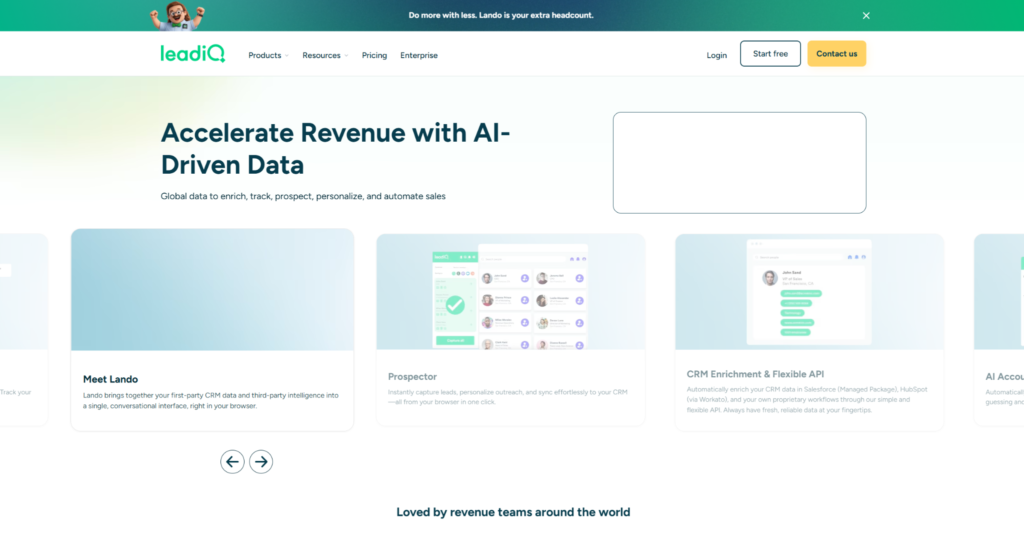
LeadIQ helps sales teams collect prospect data and organize outbound workflows efficiently. SDRs use it during LinkedIn prospecting and campaign preparation. The platform focuses heavily on prospect capture and CRM syncing. Workflow efficiency shapes its positioning.
LeadIQ combines contact collection, CRM integration, and prospect organization to reduce manual outbound tasks. Teams use it to streamline repetitive prospecting processes during active campaigns. Cleaner workflow organization improves outbound consistency across SDR teams. Workflow highlights include:
- Prospect capture workflows;
- CRM syncing support;
- LinkedIn prospecting integration;
- SDR workflow organization;
- Faster outbound preparation.
LeadIQ fits sales teams looking to simplify outbound prospect organization and CRM syncing workflows.
6. Clearbit
A business data enrichment platform.
Clearbit focuses on business data enrichment, firmographic insights, and lead qualification workflows. B2B companies use it to enrich prospect profiles and improve targeting precision during outbound campaigns. The platform positions itself around data enhancement rather than direct lead sourcing. Firmographic intelligence remains a key differentiator.
Clearbit combines enrichment APIs, company-level insights, and workflow integrations to support sales and marketing operations. Businesses use enrichment tools to improve segmentation quality and personalize outreach. Enriched business data strengthens targeting accuracy across larger outbound systems. Enrichment features include:
- Business data enrichment;
- Firmographic intelligence tools;
- Workflow integration support;
- Lead qualification enhancements;
- Outbound targeting support.
Clearbit fits businesses focused on enrichment workflows and deeper company-level targeting data.
7. 6sense
A revenue intelligence and intent-data platform.
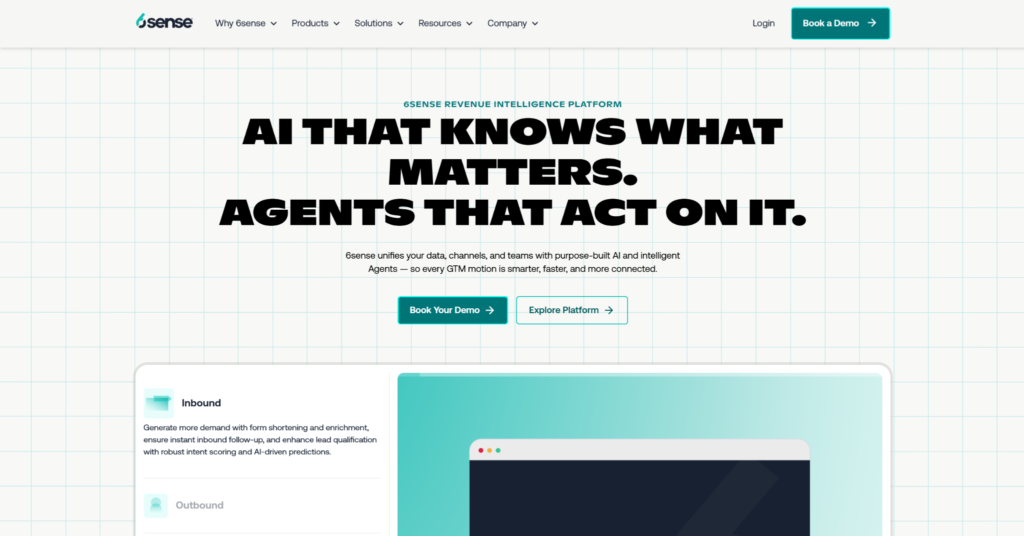
6sense focuses on intent-driven prospecting and revenue intelligence for larger sales organizations. The platform helps with account-based targeting, buyer intent analysis, and outbound prioritization. It emphasizes predictive sales signals and broader pipeline intelligence instead of simple contact lookup. Advanced sales environments get the most value.
6sense combines buyer intent insights, account-level intelligence, and predictive analytics to help sales teams prioritize outbound activity. Larger organizations use intent data to improve timing and account selection during prospecting. Predictive workflows influence outbound strategy across longer sales cycles. Revenue intelligence features include:
- Buyer intent analysis;
- Predictive account insights;
- Revenue intelligence workflows;
- Account-based targeting support;
- Outbound prioritization tools.
6sense works best for larger organizations using intent-driven prospecting and account-based outbound strategies.
Matching the Right Tool to Your Sales Workflow
Different B2B data tools solve different operational problems. Team structure, outreach strategy, and prospecting complexity all factor in. Some businesses need manual verification and cleaner segmentation. Others need enrichment systems, predictive intelligence, or faster contact lookup. Outbound teams should evaluate tools based on workflow fit, not the largest feature list. Let us wrap this up.
Final Thoughts
Modern B2B sales workflows depend on accurate prospect data, stronger segmentation, and cleaner outbound execution. Different platforms approach contact discovery, enrichment, and targeting from very different angles. Some focus on workflow speed. Others emphasize predictive intelligence or manual verification. There is no one-size-fits-all answer.
Evaluate B2B data tools based on targeting quality, workflow compatibility, enrichment depth, and outbound priorities. Cleaner prospect data creates better long-term outreach performance than larger but weaker contact databases. The right workflow structure improves consistency across outbound campaigns and SDR operations. Make smarter prospecting decisions. Execute more efficiently. That is how you win.